
 |







Test Stand Blows Away Older Methods The company worked with system integrator Quality Industrial Services (QIS), also of La Porte, to develop a test stand using a variable frequency AC drive that could test both the 50-Hz and North American 60-Hz ratings. The solution developed by QIS involved an inventive system that integrated an AC drive, industrial operator interface, and a powerful processor. The system eased operator use, increased testing cycle time, and helped NYB to conform to markets other than North America. Testing for performance Previous testing methods had several disadvantages, which NYB directly addressed when designing the new test stand. Fan and blower motors were tested using across-the-line starters with simple 220-, 440-, and 575-V output transformers activated by a start/stop button. The test stand consisted of four separate power leads from four 220- and 460-V boxes, each with its own set of fuses. In response to increasing 50-Hz demand, NYB worked with QIS to design a new testing machine that would provide variable Hertz testing capabilities, offer current limiting features, and be portable to eliminate time-consuming inter-plant product transport. The solution included an Allen-Bradley 1336 PLUS™ AC drive with variable-frequency control, PanelView™ operator interface, and SLC™ 5/03. "The main reason we wanted the drive was to be able to portably test 50-Hz fans and motors along with our standard 60-Hz products," says James Malkemus, NYB man manufacturing engineer. "When we installed the drive on the test stand, we discovered we could do a lot more than just regulate frequency. We were able to increase operator ease of use, add motor-testing flexibility, and improve safety and testing cycle time." Getting operators on board The new system allows operators to select required Hertz during testing, which solves NYB's original need for 50- and 60-Hz testing requirements. The test stand design led to quick operator acceptance, in addition to increased testing capabilities. "When we installed the new test stand, very little operator training was required," says Malkemus. "Operators quickly understood how to use the system, due in large part to the menu-driven operator interface. In addition, it offered a safer alternative than our old methods." Previous testing methods involved starting motors across the line, which created potentially high current levels and very high voltage levels. If power leads were accidentally dropped on the ground, a very serious threat of flash and burn could occur. Operators can now ramp up to set voltages, which provides a safer testing environment by controlling power lead amperage. Current limiting feature
The ramp-down feature of the 1336 PLUS is also adding value to NYB. Previously, fans and blowers had to coast to a stop, often taking minutes. Since operators would start and stop motors often during testing, precious time was lost as operators waited for rotating parts to completely stop. Now, operators can enter ramp-down times to command the drive to brake the fans and blowers—so they stop more quickly. This significantly decreases testing cycle times. "The reason we chose the 1336 PLUS was for its frequency varying capabilities, and we found out that there were a lot more advantages—especially with the current limiting that we can actually control," said Malkemus. The new portable test stand quickly became popular among operators at NYB's multiple facilities. As a result, 12 months after the 125-hp stand was first used on the floor, NYB added two additional test stands, one with a 125-hp 1336 PLUS drive and one with a 250-hp 1336 PLUS. Now, operators at each of NYB's plant buildings can take advantage of the test stands' variable frequency features, faster cycle times, and ease of use. The result: increased product quality and throughput, which helps NYB compete in the worldwide market. |
 The New York Blower Company (NYB) in La Porte, Indiana, designs and builds fans and blowers for a variety of commercial and industrial applications, such as ovens and pollution control systems. Founded in 1889, NYB has kept pace with its customers' needs by using innovative product testing while its products are being designed and manufactured.
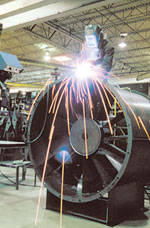 More than 300 fans and blowers are manufactured each week at NYB, and each is tested before shipment. This critical, final step in the manufacturing process ensures proper fan and blower speed, rotation, and balance. More importantly, it safeguards the company's reputation as a supplier of premium-quality products.
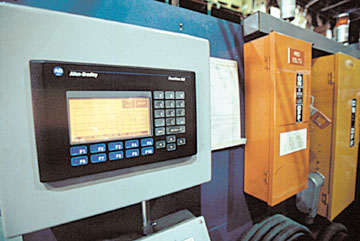 To be effective, the test stand had to be operator friendly. NYB and QIS developed a test stand integrating a 125-hp 1336 PLUS drive with an Allen-Bradley PanelView operator interface and SLC 5/03 processor. The system's technical complexity is surpassed by its ease of use. Operators can now choose testing parameters from the PanelView menu, allowing them to vary up to 12 preset parameters such as voltage, frequency, current limits, overloads, and ramp-up and ramp-down times. The messages are relayed from the PanelView through the SLC 5/03 processor to the drive. All commands are instantly verified to ensure safe, accurate operation.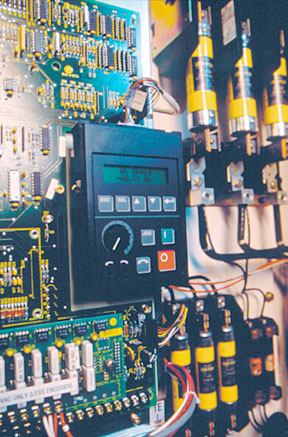
Designed by Aradise Productions, Inc.